Modules & Organization
Organization
This course will introduce students to responsive mobile environments and encourages them to explore speculative terrains that intersect art, technology and design and space. Iteratively, introducing students to the idea of responsive mobile environments, the first half of the semester will tour facets of connected devices and intelligent spaces through readings, applied explorations and guest lectures. The second half of the semester will be organized as an applied, open-ended, collaborative project.
Modules
- Week 1: Introductions: That Which is Hidden
- Week 2-5: Investigation I - Animistic Alternatives
- Week 6-9: Investigation II - Machine Assisted Beliefs
- Week 9-13: Investigation III - Haunted [Smart] House
- Week 14: Synthesis and Reflection
- Weeks 15: Showcase - Exhibition of Haunted [Smart] House
About the Modules
Introductions: Lays the foundations for the course. Mini-assignments will be used to: introduce course participants, identify constraints, open questions, challenges, and assumptions and find opportunities for investigation.
Investigations: A series of small collaborative exercises that build towards a bigger vision. The format is rapid explorations of a theme, idea or theory. During this time:
- Students will be introduced to concepts through invited guest lectures;
- Students will research and documented a questions, ideas and topics of personal interest in responsive mobile environments and related to the theme.
- Students will respond to ideas around responsive mobile environments and the studio theme with a series of rapidly assembled prototypes, conceptual explorations, and thought-exercises;
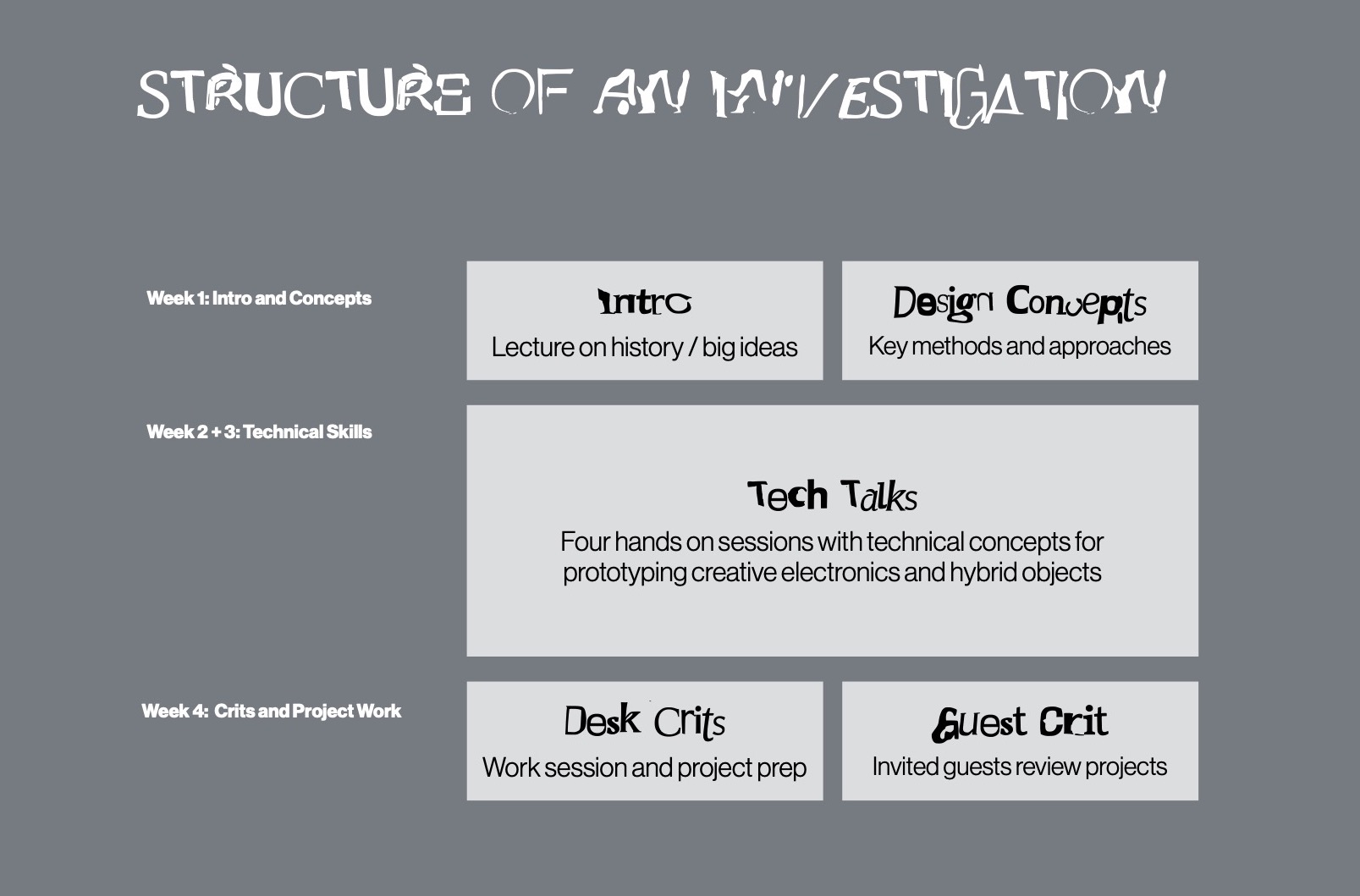
Each investigation will run over four weeks and will offer:
- Design Concepts (2 classes): an introduction to key concepts and considerations surrounding the responsive objects and spaces through readings, lectures, and in-class discussion
- Technical Skills (4 classes): labs will develop students skills in preparing responsive mobile environments and cover hardware, software, electronics and other lab skills.
- Applied Critique (2 classes): Concepts and Skills will be applied in short and focused creative projects which will then be critically examined through group critique.
Students will complete a regular creative exercise to develop conceptual understanding, refine and acquire skills and receive feedback on their ideas. Students will also be expected to complete a report on a topic of interest to them and relating to responsive mobile environments to demonstrate their review and understanding of the space.
In the final investigation, collaborative teams will work together to identify a shared approach for a critically-informed responsive mobile environment, prepare a working prototype, and deliver supporting process and outcome documentation.
Syntheis/Reflection: A week of reflection where the class as a whole will review design explorations in the course, discuss and debate the strategies from the final investigation, and synthesize a common vision for a large collaborative showcase at the end of the semester.
Showcase: The final investigation will become the basis of the final showcase/exhibition. Collectively the students will realize a series of integrated components that prepare a interactive, connected and thought-provoking experience for guests to the final exhibition. For the showcase, students will:
- refine a demonstration of their idea (a working prototype) from investigation III for public engagement;
- develop a project plan and set of needs to showcase their work in the exhibition;
- prepare supporting materials (explainers, pamplets, exhibition labels, etc.); and
- develop technically complete and well-illustrated documentation explaining their outcome;
For this phase, students will work in collaborative teams and will be tasked with translating outcomes for broader engagement, debate and dialog. In-class times will be used to facilitate instructor feedback, critique sessions and group meetings.
Deliverables
The course will largely take a design-build approach. Students will be expected to prepare three main outcomes regularly.
Within each Investigation, we’ll engage in a range of small activities to creative explore terrains and topics. These will include:
-
Case Studies - Students will uncover interesting precedent projects, labs, spaces, sites that are directly related to a creative project and the themes of the module. Students will synthesize and share a short report on these discoveries with the class.
-
Think Pieces - Students will prepare five short essays that provide thought-provoking perspective on topics related to the course. Students will independently research, review and synthesize literature, theories, research and concepts from the field into a 750-word statement that demonstrates thinking, raises questions and shares a critical and insightful perspective with their peers.
-
Project Logs - Within each investigations, students will prepare a short weekly update of their journeys with technical experiments, project exploration, and critcal making. The post will share what they have made, what they discovered through the act of making, and illustrate their work with photos, code, videos, etc.
-
Creative Explorations - During investigations, we’ll use creative experiments to try out ideas in low-stakes practices. These will range from quick design mock ups through to conducting home tours and interviews or engaging in out-of-class experiences that build first-hand knowledge of our topics.
Major deliverables will be
-
Investigation Projects - Students will develop an experiential prototype or speculative design based on ideas introduced in the course. The prototype should be accompanied by clear documentation that describes to include realization, implementation (code, design files), context (explanation, rationale, precedents and background), and concept (vision video, goals, objectives, etc.).
-
Final Showcase / Exhibition - Students will collaboratively realize an exhibition of outcomes from the course that showcases a critical perspective on technology. This will be realized as a series of experiential prototypes, along with supporting materials, conceptual designs and technical experiments, to build dialog with broader audiences around the course themes.
-
Oral Presentation and Demonstration: - Both the investigations and exhibition will culminate in a critique/review, which may include invited guests. Outcomes from creative project will be presented and demonstrated to peers, instructor, and invited guests. Students should prepare supporting documentation and a narrative for their demonstration to showcase their ideas and exploration.
Tools and Technology
As part of the course, we’ll use a few digital tools to help keep track of goings on, ideas, outcomes and process.
The IDeATe Gallery: All assignments will be documented and shared through the IDeATe gallery. It’s an online documentation platform where students from across IDeATe programs will present and share their work. It’s designed as a flexible and supportive tool for your work and specifically designed for the IDeATe program. Read more on using the Gallery.
Slack: We’ve created a Slack to give the course community an easy way to connect and communicate. Slack is a fun new platform for group conversations in open channels. Use the course slack to share ideas, post open challenges, or items that need exploration, share projects, papers or research you encounter, and discuss next steps. Read more on using the course Slack.