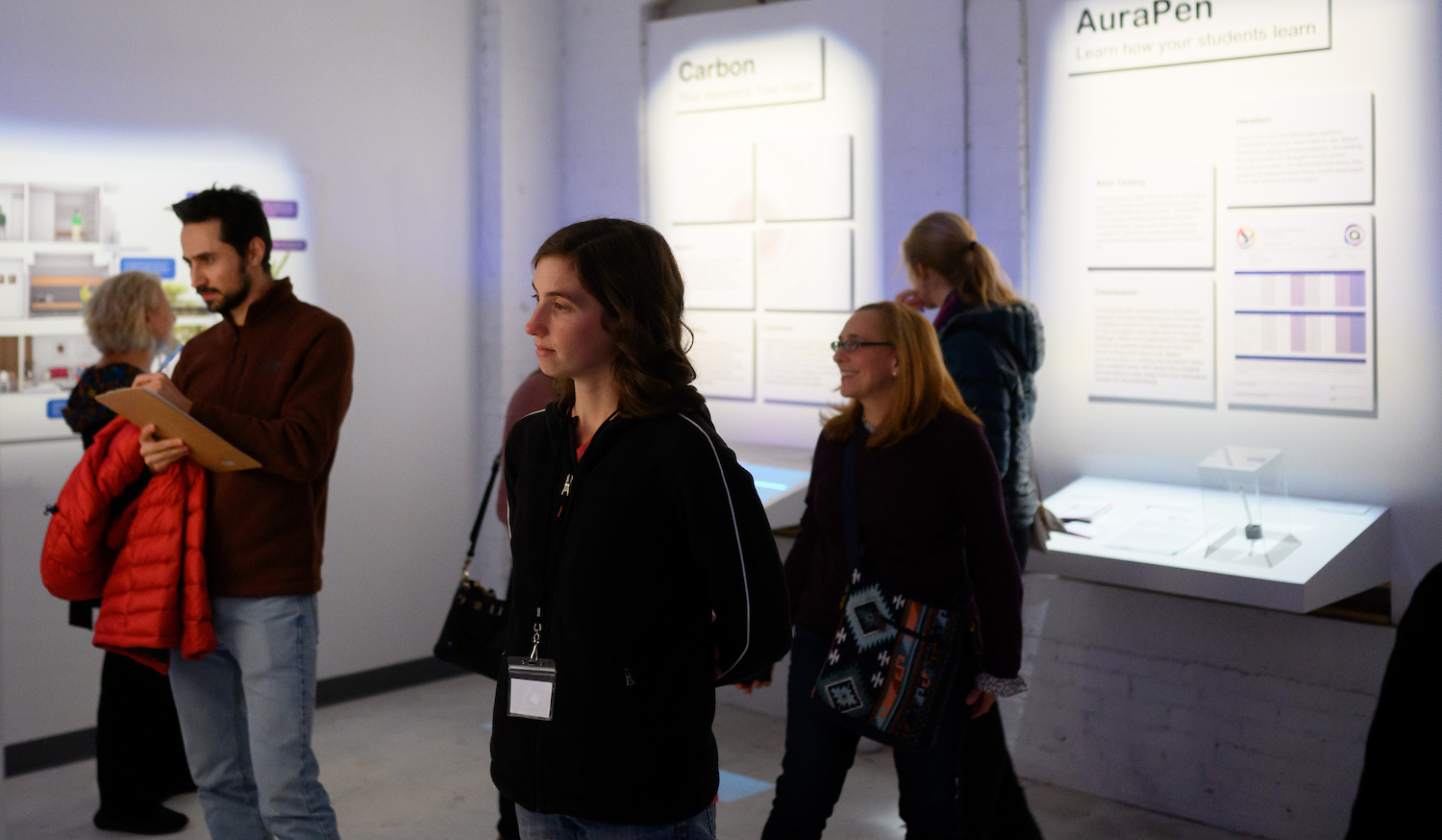
Investigations are a series of small exercises designed to explore a conceptual space and culminates with a made artefact. The format is rapid explorations of a theme, idea or theory. This investigation will be organized in three parts: first, a short series of exercises to become familiar with developing discursive concepts and prototypes; and second, two weeks of introductions to technical prototyping, and finally a collaborative exploration that generates a critically-informed discursive design.
Over the last two module’s we’ve explored how spooky technology can be a resource for critical inquiry around technology, at smaller scale and through objects. Now, we’ll shift the frame in a couple of ways. We’ll move beyond small objects and start to think about broader scenarios — we’ll prepare smart and augmented spaces at the scale of rooms and buildings. In this final exploration, you can also build on the investigations earlier in the semester and work together to identify a topic of interest interest. Working collaboratively, you’ll develop a proposal for speculative, critically-informed responsive mobile environment. The objective isn’t just to prepare a well-resolved prototype but to engage broader audiences in dialog around the work we produce in this course.
Specifically, we’ll explore an imaginary smart home – one in which IoT devices are haunted by supernatural beings; where specters, familiars, or gremlins are fundamental components of of smart devices. We will use this imaginary home as a ground for critical making. Taking cues from ‘Networked Anxieties’ by Pierce and DiSalvo and ‘Uncomfortable Interactions’ by Benford et al, we’ll continue to explore otherworldly design opportunities applied to tangible, ubiquitous and responsive technologies. First, we’ll imagine a series of alternative supernaturally-informed smart home products. We’ll situate them within a room of our haunted house. We’ll develop an immersive interactive installation, sited in this room, where guests can encounter this alternative product and how it would be experienced. We may even network interactions between these rooms. We will ultimately stage an open invitation for guests to tours this haunted house. Through this performance and installation, we will hope to build dlalog and reflection on our increasingly networked world and raise issues for public conversation through a supernatural, otherworldly, and spooky frame.
This project gives you the opportunity to explore themes, ideas and concepts of interest to you but within the scope of this courses them. This makes it a timely moment to revisit the goals for this course:
“In the case of telegraphy and wireless, in other words, many believed telegraphs and crystal sets could be used to contact incredible and unseen yet equally ‘real’ worlds, be they extrasensory or extraterrestrial. The ethereal ‘presence’ of communications without bodies suggested the possibility of other similarly preternatural interlocutors, invisible entities who, like distant telegraph and wireless operators, could be reached through a most utilitarian application of the technology.… the telegraph and early wireless held the tantalizing promises of contacting the dead in the afterlife and aliens of other planets.” - Jeffrey Sconce, Haunted Media, p10
We often hear that the technologies in our everyday lives would appear to be ‘magic’ and potentially terrifying to people in the past—instantaneous communication with people all over the world, access to a vast, ever-growing resource of human knowledge right there in the palm of our hand, objects with ‘intelligence’ that can sense and talk to us (and each other). But rarely are these ‘otherworldly’ dimensions of technologies explored in more detail. There is an often-unspoken presumption that the march of progress will inevitably mean we all adopt new practices and incorporate new products and new ways of doing things into our lives—all cities will become smart cities; all homes will become smart homes. But these systems have become omnipresent without our necessarily understanding them.
“Today the cloud is the central metaphor of the internet: a global system of great power and energy that nevertheless retains the aura of something noumenal and numinous, something almost impossible to grasp… It is something we experience all the time without really understanding what it is or how it works. It is something we are training ourselves to rely upon with only the haziest of notions about what is being entrusted and what it is being entrusted to.” - James Bridle, New Dark Age, p7
They are not just black boxes, but invisible: entities in our homes and everyday lives which work through hidden flows of data, unknown agendas, imaginary clouds, mysterious sets of rules which we perhaps dismiss as ‘algorithms’ or even ‘AI’ without really understanding what that means. On some level, the superstitions and sense of wonder, and ways of relating to the unknown and the supernatural (deities, spirits, ghosts) which humanity has felt in every culture throughout history have not gone away. Instead, they have transferred and transmuted into new forms.
This course is part of an on-going design-research project, led by Dan Lockton and Daragh Byrne, that has already created an inventory of ‘spooky technologies’. Continuing this inquiry, we will examine people’s understanding of systems in their homes, such as connected devices, information flows, voice assistants, and highlight beliefs and superstitions that emerge around them. What are unsettling moments in the smart home—what do people assume when things breaks down? In tandem, we’ll examine work across art, design, and human-computer interaction, explore the history of the supernatural, myths, and superstitions, and extract possibilities, insights, and opportunities.
From this, we will prototype and experiment with working examples of spooky technologies. What happens when Alexa speaks in tongues? Can computer vision read your tea leaves? What would a haunted smart home be like to live in? Can we create new superstitions—or technologies to encounter beliefs, rituals and practices?
As part of this investigation, you will:
Conceptual
Technical
| Date | Type | Description |
|---|---|---|
| Mar 28 | Concepts | Networked Anxieties and Network Imaginaries |
| Mar 30 | Concepts | Design Methods #3: Defamiliarization and Uncomfortable Design |
| Apr 4 | Tech | tinyML with OV7675 camera module |
| Apr 6 | Tech | Introduction to wirless communications: BLE, OSC, NFC, & RFID |
| Apr 11 | Tech | Context-aware microcontrollers with UWB |
| Apr 13 | Tech | No Class: Spring Carnival |
| Apr 18 | Desk Crits | Group work & desk crits |
| Apr 20 | Crit | Review of outcomes with invited guests |
| Due Date | Deliverable | Details |
|---|---|---|
| Mar 30 | Case Study | Identify and describe a case study that explores a concept related to this module. Share on Slack in #cases |
| Apr 4 | Think Piece | Research a think piece on network imaginaries and network anxieties on Slack in #thinkpieces. |
| Apr 6 | Project Log | Post a short update on your experiments with critical making |
| Apr 11 | Project Log | Post a short update on your experiments with critical making |
| Apr 11 | Warm Up | Sketch a possible approach of your project in this module (2 hours max). |
| Apr 18 | Project Log | Post a short update on your experiments with critical making |
| Apr 20 | Project | Present your prototype in class. |
| Apr 21 | Documentation | Deliver documentation of your creative project |
Do some research and find an existing creative work that relates to this module. Review examples from Spooky Tech module first. Identify and report on an example (research project, artistic installation, design project, etc.) related to the themes of the module: animism, enchantment, agency, intelligences, etc. The focus here is on discovering a product or project that you didn’t previously know about and represents an interesting approach, method or strategy that can inspire our work in this module. Read the full description.
On Network Imaginaries and Network Anxieties: To help prepare for your project, research and report on a topic directly related to the themes of the module: relationship between smart and intelligent devices and their unsettling effects. Prepare 500-750 words (max) in a short essay on a topic of interest that elaborates a critical point of view, raises a question, or provoke conversation. Read the full description.
Ghost Stories Working as a group, draw up a short speculative proposal for this project in the form of a ghost story. Try to imagine an encounter with your proposed object and the world around it. To do this, we’ll imagine the folklore, fables, myths and ghost stories that might be told about your haunted devices. Use this to thing through and communicate the unexpected, uncomfortable, unsettling or strange experience you are hoping to create. Complete this in no more than 2 hours. Read the full brief.
Engage a line of spooky inquiry and by working in small groups, develop a piece for a larger exhibition that will engage invited guests (and potentially wider audiences) in Spooky Technology. Each group will prepare one prototype with supporting diagetic props and materials. Collectively, these prototypes will relate and/or network with one another through an immersive space. Read the full brief.
Review For Class
| Date | Description |
|---|---|
| Mar 28 | Byrne, D., Lockton, D., Hu, M., Luong, M., Ranade, A., Escarcha, K., Giesa, K., Huang, Y., Yochum, C., Robertson, G. and Yeung, L., 2022, June. Spooky Technology: The ethereal and otherworldly as a resource for design. In Designing Interactive Systems Conference (pp. 759-775). Davis, Erik. TechGnosis: Myth, magic, and mysticism in the age of information. North Atlantic Books, 2015. |
| Mar 30 | Excerpts from Spooky Technology. Section: ‘IoT and Ubiquitous Prescences ‘ Steve Benford, Chris Greenhalgh, Gabriella Giannachi, Brendan Walker, Joe Marshall, and Tom Rodden. 2012. Uncomfortable interactions. CHI ‘12. https://doi.org/10.1145/2207676.2208347 |
Below is a list of additional online material that relates to the module and provides a starting point for your explorations. This is by no means exhaustive i.e. you should read/research beyond it.
Hauntings and Unsettling IoTs
Davis, Erik. TechGnosis: Myth, magic, and mysticism in the age of information. North Atlantic Books, 2015.
Byrne, D., Lockton, D., Hu, M., Luong, M., Ranade, A., Escarcha, K., Giesa, K., Huang, Y., Yochum, C., Robertson, G. and Yeung, L., 2022, June. Spooky Technology: The ethereal and otherworldly as a resource for design. In Designing Interactive Systems Conference (pp. 759-775). https://doi.org/10.1145/3532106.3533547
James Pierce and Carl DiSalvo. 2018. Addressing Network Anxieties with Alternative Design Metaphors. In Proceedings of the 2018 CHI Conference on Human Factors in Computing Systems (CHI ‘18). Association for Computing Machinery, New York, NY, USA, Paper 549, 1–13. https://doi.org/10.1145/3173574.3174123
James Pierce. 2019. Smart Home Security Cameras and Shifting Lines of Creepiness: A Design-Led Inquiry. In Proceedings of the 2019 CHI Conference on Human Factors in Computing Systems (CHI ‘19). Association for Computing Machinery, New York, NY, USA, Paper 45, 1–14. https://doi.org/10.1145/3290605.3300275
Performing Technology Concerns
Michael Skirpan, Maggie oates, daragh Byrne, Robert nd Lorrie Faith Cranor. Is a Privacy Crisis Experienced, a Privacy Crisis Avoided?: Exploring immersive theatre as a way to educate audiences and study their perceptions of privacy and technology ethics.
Tennent, Paul, Stuart Reeves, Steve Benford, Brendan Walker, Joe Marshall, Patrick Brundell, Rupert Meese, and Paul Harter. “The machine in the ghost: augmenting broadcasting with biodata.” In CHI’12 Extended Abstracts on Human Factors in Computing Systems, pp. 91-100. 2012.
Designing Experiential Futures
Candy, Stuart. “Time Machine/Reverse Archaeology.” Retrieved 11.11 (2013): 2014.
Discursive Design and Design Imaginaries
Tharp, B. M., & Tharp, S. M. (2019). Discursive design: Critical, speculative, and alternative things. Cambridge, MA: MIT Press.
Mark Blythe. (2014). Research through design fiction: narrative in real and imaginary abstracts. In Proceedings of the SIGCHI Conference on Human Factors in Computing Systems (CHI ‘14). ACM, New York, 703–712. doi:10.1145/2556288.2557098
Designign for Discomfort
Benford, Steve, Chris Greenhalgh, Gabriella Giannachi, Brendan Walker, Joe Marshall, and Tom Rodden. “Uncomfortable interactions.” In Proceedings of the sigchi conference on human factors in computing systems, pp. 2005-2014. 2012.
schraefel, mc, Aaron Tabor, and Elizabeth Murnane. “Discomfort design.” Interactions 27, no. 2 (2020): 40-45.
Immersive Theatre
Haunted Houses in Technology Research
‘Museum of Failed Products’ for Bricolage’s Project Amelia
Read more in No Proscenium or view this episode of PBS “Immersive World” shows details about the performance: https://to.pbs.org/33MP8QC
The Future Energy Lab.
Superflux(2017).
https://superflux.in/index.php/work/futureenergylab/#
One of the things we find in our work that is really challenging for people to do, is to move from a place of feeling safe, and certain, to being able to embrace uncertainty, and not freak out about it. To give them some sense of control, to give them a means to work with the future.
And this was one of the key challenges we addressed in our work with the Government of UAE. The Ministry of Energy and the Prime Minister’s Office invited us to help them to not only develop a mechanism to experience numerous possible futures around energy, but more importantly, to stress test the opportunities and broader systemic consequences of each future with Cabinet Ministers and key decision makers. The ambition was that such collaborative futuring activity would help inform the country’s energy policy all the way till 2050.
Future Energy Zone from Superflux on Vimeo.
Grow Your Own.
Science Gallery Dublin (2013–2014).
https://dublin.sciencegallery.com/growyourown
The Science Gallery presents pressing science and technology topics, including contagion, biomimicry, hacking, and AI, through art-science programming. Here the curatorial team included leading experts in synthetic biology and biohacking working with prominent critical and speculative design creators. Programming included participatory workshops on DIY biohacking, installation artworks, documentary films, lectures, and events prepared in collaboration with researchers, designers, and entrepreneurs.
This example is included to illustrate how experiential futures can be used as a vehicle to engage experts and public audiences alike.
The Museum of the Future. World Government Summit, Dubai (2015–2019). https://designawards.core77.com/Interaction/60316/Museum-of-the-Future-Machinic-Life
An annual popup exhibition staged as part of a global conference of policymakers, the Museum of the Future was as a design-led companion to the annual World Government Summit. The 2016 iteration offers a thematically relevant example, about “exploring the future impact of current advancements in robotics and artificial intelligence on society… ask[ing] the world leaders and general public who attended: What does [this] mean for society, for government, and for our families? What conversations should we be having today to prepare for a better tomorrow?”
This case exemplifies experiential scenarios (physical speculative design installations in this instance) supporting and inspiring policy conversation at the highest levels.